

On Joy

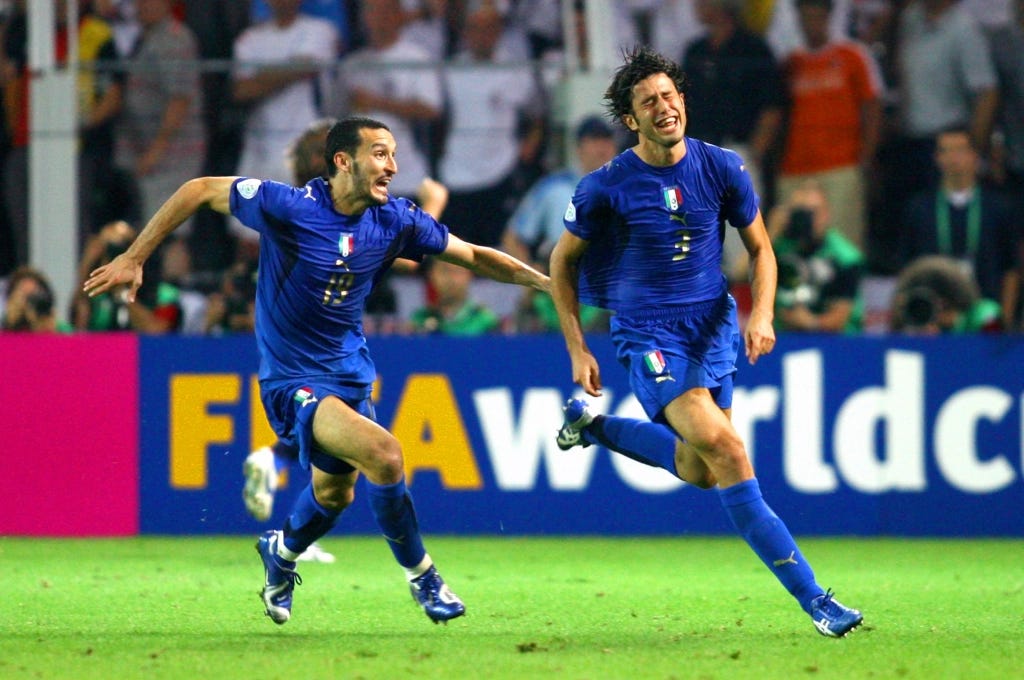
They run—or seem to—in a split second that promises both motion and immutability: two men1 in identical blue, mouths opened as if some wordless syllable has finally found a body, limbs thrown wide in contradictory gestures of release and rehearsal. Behind them, the stadium falls out of focus—crowd faces collapsing into a single coarse texture, advertising boards and sweat-sheened fabric receding alongside the strict geometry of turf and touchline. All of it becomes merely a shallow stage for the real drama: two bodies, for a moment, unmoored from consequence. The photograph arrests them mid-euphoria and, in doing so, renders joy as a thing that can be studied like a fossil: the curl of a lip, the flex of a calf, the way fingers splay as if to catch light.
If joy has a portrait, it is not this photograph and yet it is also exactly this: not the fact of a win or a goal or a scoreboard change, though those are the proximate causes and the narrative scaffolding, but the unaccountable conversion of a public event into an inner weather. Joy, in the photograph, is not simply happiness mapped onto muscle—it is also a politics of exposure and risk: eyes trusting the world to be as luminous as they feel, mouths and chests daring the air to corroborate them. The players’ faces are neither carefully arranged nor curated; they are, rather, the last honest element in a spectacle designed to be consumed. That honesty is what arrests the eye: how small and how large a thing it is to allow oneself to break, for a beat, into laughter or song2.
There is evidence here that joy is not simply a consequence but a form—an emergent property of bodies, context, memory, and the peculiar social gravity of witnessing. Gianluca Zambrotta reaches not so much for Fabio Grosso as for a proof: a hand extended to be held, a mirror held up to the other’s face so that both can recognize, in each other, the same confirming light. Joy, we learn, desires company3; it is a social contagion whose currency is eye contact and the small, readable signals of the body.
This compulsion to be witnessed is not, however, merely narcissistic. There is a primitive logic to it: the world becomes safe for joy only when it is acknowledged. The public forum of the stadium, the thrumming mass of strangers, gives the image of joy its oxygen. It is not private contentment, but the violent, generous conversion of capacity into performance. Joy in public is a kind of civic act. It tells the city—whatever the city may be, from a dusty neighborhood to an electric stadium—that here, now, is a moment that will not be wholly captured by commerce or calculation. Even commodity economies—the advertising boards, the corporate logos—are recalcitrant extras in the photograph’s drama. They lurk at the periphery like unpaid witnesses, impotent to contain the primitive burst at the center.
Tilt toward philosophy and we might say that joy interrupts fear. Fear tightens the self; it shrinks the body and mind into the narrow arithmetic of risk and self-preservation. Joy does the opposite: it enlarges. It widens the aperture of perception, transfigures scarcity into abundance, and in that widening approaches a moral clarity. To feel joy in the presence of real stakes—in a match that could still be lost, in a career always one misstep from ruin, in any moment where the cost is measurable—is to declare that not all goods submit to calculation. The men in blue are not announcing that the sum of their choices has been vindicated. They are insisting, instead, on the reality of a value that exceeds the jurisdiction of odds.
There is also a temporal violence to joy. The photograph, being a photograph, will outlast the men’s breath. It freezes an event prone to evaporation and, paradoxically, both diminishes and magnifies it. Diminishes because the arrow of cause and consequence is collapsed into a cut: we do not see the minutes before and after the goal, the private anxieties, the slow accretions of training, the weariness that preceded this ecstasy. Magnifies because the freeze-frame allows an intimacy of inspection that the live experience does not afford—you can read the smallness of a throat, the precise spit of light on fabric thread, the way a shoulder blades bunch. Art often works this way: it amputates chronology to reveal structure. Joy, when amputated, becomes doctrinal in its clarity; its anatomy can be laid out.
But to translate joy into doctrine is to kill it. What remains is not the instruction manual but the puzzle. Joy is, in its rawest form, a refusal of narrative propriety4. It insists on being sudden, on breaking the predictable course of things. This is why some cultures mistrust joy, why decorum trains us to restrain our brightness, practicing a quiet deterrent against happiness that refuses to stay small. Joy suggests an openness that unsettles institutions: it is an existential interruption of the ordinary. Consider how often public joy is policed, made to bow to etiquette, calmed into an acceptable range so as not to alarm the comfortable.
The photograph also teaches us about proportion. The stadium’s scale renders the players small but the gesture enormous. There is an economy in that: joy need not be proportionate to its cause. A minor triumph can produce a disproportionate joy; conversely, a monumental success may be met with a terrible, anti-climactic flatness. This disproportionality is a fact of the human condition. We do not calibrate response perfectly to stimulus; we are, in our feeling, extravagant and stingy in ways that defy prediction. The men’s exuberant sprint is not a precise metric of value but rather a measure of what the body and the mind find irrepressible.
Yet there is also a cautionary note: the photograph can be consumed. Joy can be commodified. The advertising panels in the background tell a different story: that the spectacle of joy is also supply to a marketplace. This dual fact—that joy both resists and is susceptible to commodification—is the ethical knot the image places before us. We admire the players’ abandon and, simultaneously, our admiration can be re-routed into consumer desire. Their gestures, once photographed, can serve narratives that have nothing to do with the men who made them5. Here is a consolation and a warning: the authenticity of joy lies in its immediacy; its afterlife, in being turned into iconography, cannot repurchase that immediacy.
So what remains to be said about joy? Perhaps only that it is an ethical posture as much as an emotion—a wager on the world’s willingness not to betray us. To feel joy is to risk being changed; to show it is to expose the softest part of the self to strangers; to sustain it is to withstand the machinery eager to convert every human brightness into currency. The photograph teaches this without ceremony: a brief concord of bodies and breath, an uprising of trust against the cold calculus of outcomes. It reminds us that life is not measured in victories but in these sudden ruptures of light—moments when a throat opens and a body, for once, refuses restraint, insisting that abundance is possible. Joy is not an indulgence. It is proof of life, and the courageous declaration that being alive is still worth the risk.
Gianluca Zambrotta and Fabio Grosso, two Italian footballers, in the wake of Grosso’s decisive late goal against Germany in the 119th minute of the 2006 World Cup semifinal.
“Non ci credo!” (”I don’t believe it!”) says Grosso, incredulous, as he celebrates.
To rejoice is to acknowledge dependence. One cannot be joyful alone, at least not for long; even private joy imagines a witness, even if that witness is only a future self recalling the scene.
Joy resists interpretation because it is, by nature, pre-verbal—an eruption rather than a report. Consider the passionate outburst from Sky Italia’s commentator, Fabio Caressa: “GROSSO! GROSSO! GOOOOOLL! GOL DI GROSSO! GOL DI GROSSO!” The moment we begin to explain joy, we participate in its diminishment, like a scientist dissecting a bird to understand flight and finding, finally, only feathers.
Every photograph of triumph contains an unphotographed despair—the missed penalty, the overlooked players beyond the frame, the millions whose gestures of joy were stifled by another’s success. Joy, therefore, is never innocent; it invariably carries the weight of those excluded from its light.